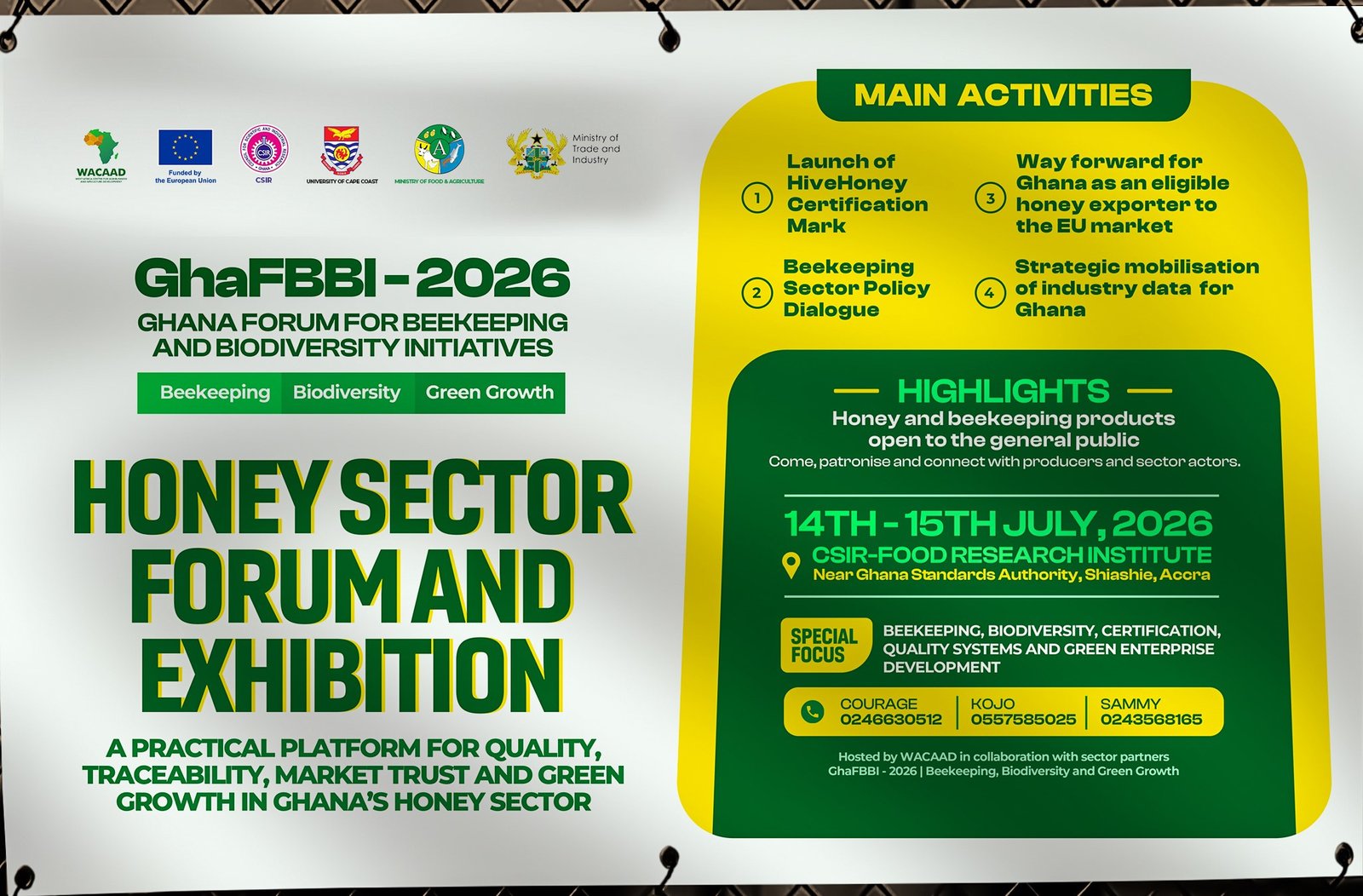
Accra, Ghana — 17 July 2026. Ghana’s apiculture sector held its first-ever national conference this month, as the Ghana Forum for Beekeeping and Biodiversity Initiative (GhaFBBI 2026) convened 100 stakeholders in Accra for two days of technical sessions, product exhibitions and policy dialogue aimed at reshaping the country’s honey industry.
Organised by the West Africa Centre for Agribusiness and Apiculture Development (WACAAD) with funding support from the European Union Delegation to Ghana, the forum ran from 14–15 July at the CSIR-Food Research Institute in Shiashie, Accra, under the theme “Beekeeping, Biodiversity and Green Growth.”
A Deliberately Mixed Room
Rather than a commemorative gathering, GhaFBBI 2026 was designed as a working forum. Its 100 participants were drawn in defined proportions: 25 beekeepers and producer groups, 15 honey processors, aggregators, packers and marketers, 10 women and youth enterprise groups, 12 regulators, standards bodies and laboratories, 8 academics and technical experts, 10 development partners and buyers, and 8 media houses — a composition chosen to keep the meeting representative while remaining technically focused and manageable.
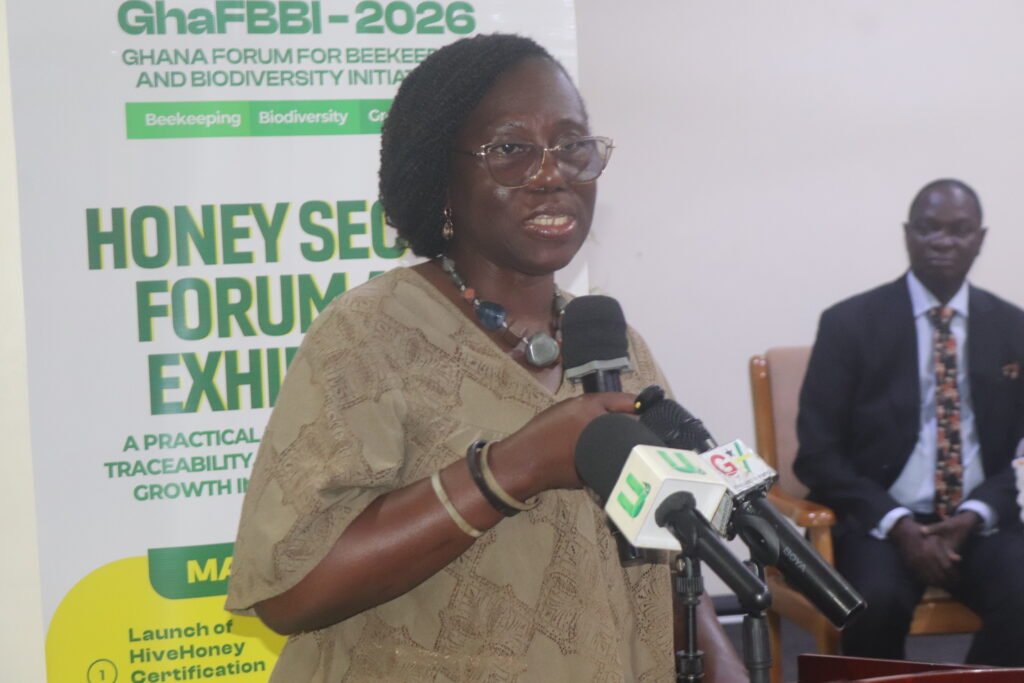
Opening the forum, Dr. Courage Komla Besah-Adanu, Lead Consultant at WACAAD, called it a pivotal moment for the sector and urged a shift away from simply celebrating honey as a product toward building the underlying systems — quality assurance, traceability and institutional coordination — that a credible, export-ready industry requires.
Six Themes, One Roadmap
The programme was structured around six themes: the launch of the HiveHoney Certification Mark; a policy dialogue on honey quality and market confidence; traceability, standards and compliance tools; biodiversity, pollination and green growth; women, youth and inclusive enterprise development; and a coordinated media and public-awareness campaign to build national recognition of the mark.
Each session fed into a closing set of stakeholder commitments. Bringing the forum’s technical proceedings to a close, WACAAD Executive Director Dr. John Kojo Ahiakpa laid out a seven-point roadmap, including designating a single government agency for long-term sector leadership, WACAAD-led promotion of the HiveHoney mark, a review of Ghana’s 2015 national honey standard, a centralised digital database of production data, a “single testing” model to cut duplicated quality checks, stronger producer cooperatives with shared processing infrastructure, and coordinated mobilisation toward a national apiculture policy.
Voices from the Floor
Delivering the keynote address, Rev. Prof. Peter Kofi Kwapong, WACAAD’s Board Chair, described bees as “silent heroes” and “economic engineers” whose pollination work underpins food security across crops from cocoa and shea to tomatoes and citrus — a theme that ran through much of the forum’s biodiversity programming.
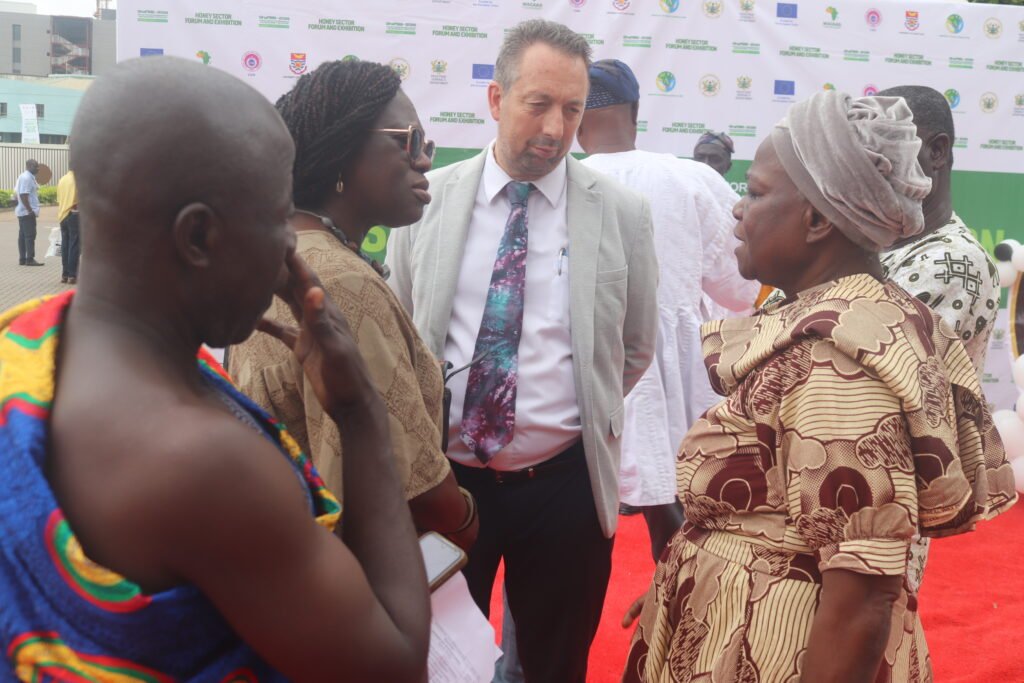
Government and development-partner voices reinforced the sense of a sector at a turning point. Representing the Food and Agriculture Organisation, Mr. Clifford Adagenera congratulated WACAAD on the forum and pledged continued technical support through FAO’s Forest and Farm Facility. The event’s implementation also drew in the Ghana Standards Authority, the Food and Drugs Authority, the Veterinary Services Directorate and the Animal Production Directorate of the Ministry of Food and Agriculture, alongside the Forestry Commission.
Beyond the Two Days
GhaFBBI 2026’s organisers have been clear that the forum’s real test lies in what follows it. Planned next steps include an authorised-user registration process for the HiveHoney mark, a practical compliance-support package for producers, a traceability toolkit for producer and batch-level records, and a light technical committee to track action points on residue-control awareness, operator registration and export-readiness support.
Closing the forum, Rev. Prof. Kwapong thanked participants for their sustained engagement over the two days, telling attendees it was the first conference he had attended where participation held so consistently through to the final session. He urged partners to carry the spirit of collaboration back to their own institutions and regions, while WACAAD confirmed that a communique and action points would be circulated in the week following the event to guide implementation.
WACAAD says GhaFBBI is intended to become a recurring national platform for the sector, rather than a one-off event, with the 2026 edition serving as the baseline for future editions to measure progress against.
This action is funded by the European Union. Its contents are the sole responsibility of WACAAD and its partners and do not necessarily reflect the views of the European Union.
Media Contact: West African Centre for Agribusiness and Apiculture Development (WACAAD) — Williams Clinton Appoh, Email: info@localhost.wacaad.org, Phone: +233 020 836 1932.